Saturday, 28 February 2009

Preparations for Exeter


"Shippo" pincushions and "Plum and Moon" Bag are my two most popular kits at the moment. I spent part of today repacking more for the Exeter Spring Quilt Festival next weekend. As the lining print I used for the original batch of the bag isn't available any more, I added dark blue, mid blue and purple colourways to the range for the Edinburgh show. Rather than restitch the bags, I've recoloured the photo to give an approximate "artist's impression" of how the new colourways look - the dark blue and the purple are much darker in real life than in my edited photo. The moon and plum branches are still stitched in cream while the blossoms are stitched in either ice blue, shaded pink or red. So there have been eight different colours available so far! The new colourways are lined with a gorgeous blue, turquoise, lilac and gold print from Kona Bay.

The shippo pincushions were originally a workshop for the Grosvenor quilt shows several years ago. I use the samples to hand out needles in my one hour workshops. I've added a darker shade of blue, burgundy, warm brown and brick red to this kit's fabric selection, keeping to the cream thread for the stitching.

Thursday, 26 February 2009

Kogin Special - for Jane and Miriam

After Jane's comment on my previous post and her request for information about kogin, here are some photos of kogin stitched by my friend Keiko Hori. She learned how to stitch kogin while visiting Aomori prefecture over twenty years ago. I didn't know she stitched it (as well as sashiko, patchwork, quilting and counted embroidery techniques) until we got chatting about it in the supermarket in Yuza on my last trip.

A couple of days later, I went to her house for a kogin lesson. I really enjoyed it, although it takes a lot more concentration than (even) the more elaborate hitomezashi (one stitch sashiko) stitches. Maybe it gets easier the more you do. This is what I stitched that afternoon (only the part on the blue).
Isn't this reversible obi stunning?


Keiko's work is beautiful. Here are some details -

Kogin is a kind of counted sashiko and is named after a koginu (a style of farmer's jacket from Aomori Prefecture). It is generally accepted to have developed from something similar to the pattern darning style of some hitomezashi (one stitch sashiko) patterns. It is counted over and under uneven numbers of threads, while a subgroup of kogin called nambu hishizashi (Nambu-region diamond sashiko) is stitched over and under even numbers of threads. There is quite a bit of information about it in the history section of "The Ultimate Sashiko Sourcebook", although actually including any specific kogin patterns were outside the remit of that book. Here are a couple of small samples I made for that book - a kogin panel first, stitched on dark blue prairie cloth -

Old pieces of kogin and nanbu hishizashi are much rarer than old sashiko. Kogin is traditionally stitched with cotton on hemp, though nowadays cotton or even wool cloth is used. Nanbu hishizashi was stitched using colourful imported wools for about thirty years at the start of the last century, but was originally cotton on hemp too. This is my nanbu hishizashi sample. I used 28-count evenweave embroidery fabric and crewel wools in the same colours as the original wools, which look like Berlin woolwork threads -

Kogin now uses coloured threads and fabrics. The thread is similar to stranded embroidery cotton.


Some pieces of sashiko stitched in Akita prefecture are technically kogin, as they are counted, like the end panel on this traditional headscarf.


I found it! Here is a chunk of text from the first draft of "The Ultimate Sashiko Sourcebook" history section, including more about kogin than appeared in the final version. The "Kitamaesen" was a trade route, from Kobe/Osaka area and up the Western side of Japan.

Kogin and Nanbu Hishizashi
Some Shonai sashiko patterns resemble kogin, a form of counted embroidery from the Tsugaru region, around Hirosaki, Aomori Prefecture. Also known as sashikogin, it is a tradition in its own right and is thought to have evolved from sashiko. Thick white cotton thread is stitched along the weft of coarse hemp fabric, over and under odd numbers of warp threads, in unique patterns. By comparison, Shonai sashiko is not a primarily a counted technique, although some older work was counted. There are three kogin styles - Nishi or western (diamond patterns and dense stripes over shoulders), Mishima or triple stripe (from the north - three bands dividing patterns on front and back) and Higashi or eastern (large overall designs continuing from front to back without a break).
Tsugaru was a prosperous rice growing area. Kogin is from koginu, a dialect word for a farmer’s unlined work jacket, first appearing in Tsugaru clan records in 1685. The local ‘Frugality Act for Farmers’ of 1724 forbade the wearing of cotton fabric, so kogin used cotton threads darned into hemp cloth. Late eighteenth century records mention kogin as farmers’ wear, mostly white on indigo, although indigo on white was used for women’s festival. Cotton was permitted after the Meji Restoration (1868) and kogin became increasingly elaborate, for special occasions and bridal trousseau. In the 1890s, the railway came to Tsugaru and factory made textiles became readily available, including wool. Kogin declined in the early twentieth century but has been revived recently.
Nanbu Hishizashi (diamond sashiko) is similar to kogin and comes from the southeast of Tsugaru, eastern Aomori and Iwate Prefectures. Counted over and under even numbers of warp threads, patterns are based on the small diamond units forming part of the Nanbu clan crest. The earliest example is believed to date from 1850s. Hishizashi was originally stitched on cheaper pale blue hemp fabric, as the area was historically less prosperous than Tusgaru, and only one layer of fabric is used. Bright aniline-dyed threads were introduced in the early twentieth century. The range of kogin and hishizashi patterns is beyond the scope of the present book but a similar effect may be obtained by adapting some Shonai patterns for counted embroidery, particularly diamonds and diagonal patterns. Any similarities of pattern between work from Shonai and Aomori seem to be coincidental. Evidence does not suggest that either tradition directly affected the other, although influence of the Kitamaesen cannot be ruled out.

Edinburgh Spring Quilt Festival, Quiltfest and more sashiko


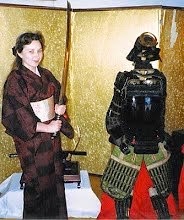
The Edinburgh Spring Quilt Festival was very enjoyable. The new sashiko workshop went down well (I'll take photos of what we do at next week's Exeter Spring Quilt Festival), the Denman Kannon stitching progressed and I met lots of interesting quilters. Everyone seemed very inspired by the quilts on show in the exhibition, including the antique quilts that were at the Malvern autumn quilt show (some wonderful wholecloths among them). I was too busy to buy much fabric, but found a few very specific pieces for projects I have planned - quilt shows are such a good place to find exactly what you need. It won't be long before I'm back in Scotland again (twice this spring) teaching two different groups. The quilt behind me in the photo is "Masu" (please scroll down link page for pattern info) made entirely from vintage Japanese kimono wools and silks. "Compendium of Quilting Techniques" was very popular and I'll be signing copies of that at Exeter too.

I worked on the clouds and halo on the Denman Kannon while I was in Edinburgh. I used a shaded blue - white sashiko thread (I think it was either Olympus or Yokota brand, but as I bought it in 1992 and lost the skein label I'm not sure). The shading helps to contribute to the glowing effect, but I want to add short 1in long lines around the outside edge, inbetween the shaded threads, using the brilliant white Olympus 40m medium sashiko thread I used around the halo edge.
I also began filling in the scales on Monday. After a lot of thought, I decided to stitch a hybrid between masu (stacking measuring boxes) and hishi seigaiha (diamond ocean wave) - details immediately below (from the pattern directory in "The Ultimate Sashiko Sourcebook"). So the tops of the diamonds have the crossed corners found on masu (the stitches don't cross on the front). Click photos to see more detail.

I considered using the hitomezashi (one stitch sashiko) pattern urokozashi (scale stitch) for the fish scales. However, I would have either had to stitch the scale outlines at half the size (i.e. dividing each scale outline into four) or have very large scales, as shown in this detail from Reiko Domon's quilt inspired by Gaudi's architecture. Only having a small amount of the hand-dyed thread I wanted to use for this section ruled out such dense stitching. I also felt that urokozashi would be slightly innapropriate as an all over pattern on the koi, since it is used in Noh drama for snake demon costumes! I used a single row of this pattern around the halo, but it doesn't read as all over urokozashi there, so I think it is OK.

First section of scales complete-

More scales - these have only 2 pattern rows instead of the 3 rows in the first section, so more of the background fabric shows through the scales in the centre section. Yesterday, I wasn't sure that looked right, but seeing the photos, I think it is the best solution. As the scales at the back of the tail are so much smaller, without enough room for 3 stitching lines and crossed corners, at some point on the fish body it would be necessary to change the number of stitching lines... tricky to get it in the right place. Plus I am trying to eke out what I have left of that lovely hand dyed thread that shades from yellow through persimmon to purple, by including very small sections of plain yellow and persimmon and another hand dye that continues the purple shading along the whole thread.

Before the extra scale details -


After - there's still quite a lot more to complete, but the stitching lines are marked in place.

What do you think? Anne took a good photo of me stitching and you can see it on her blog post about the show. Guy is right about my glasses - he commented that I look a bit fierce when I've got them on !

I went over to Quiltfest yesterday with more supplies of "Compendium..." and the place was buzzing with interest all day. I wonder if other exhibitions in public galleries around here are generating as much interest and enthusiasm? I stayed and stitched on the Kannon panel. I'll be back there on Friday and there is an extra opening day on Sunday because there is an antiques fair on at the Pavilion.

Tuesday, 17 February 2009

Denman Kannon sashiko update


The sashiko panel has progressed a bit further, with the addition of the halo details. I used the Olympus medium sashiko thread (40metre skein) on the outside of the halo, in bright white, and shaded through various white and cream sashiko threads (several brands) to a darker cream in the centre. I'm trying to make it "glow". Next I want to add more detailed stitching to the fish scales (using hishi seigaiha - diamond waves - as the pattern) and some hitomezashi patterns to the robe borders. I will also stitch the clouds at the top left before adding the striped tsumugi cotton borders and stitching the waves overlapping the border fabric. At that stage, I'll have to tape the paper pattern to a window to trace the lotus blossoms, cloud and wave details at the sides.

I'll be working on this piece at Edinburgh over the weekend.

Takenoko is unimpressed!

Monday, 16 February 2009

What's next? Edinburgh!

I'm sorting out things for the Edinburgh Spring Quilt Show, which runs from Friday to Sunday this week (I'm going to the Exter show in two week's time too).

Theone hour sashiko workshop project for this year's Grosvenor Quilt Shows (Edinburgh, Exeter, Sandown Park, Harrogate in September and Malvern's October show) is a Japanese kamon crest in sashiko - how to transfer the design and stitch it, plus tips on how to get your designs in the first place.

I decided to use a variation on the classic paulownia (kiri) crest, adapted from an antique tsusugaki panel. The leaf veins in this design are particularly interesting to stitch. The panel is 25cm (93/4in) square, a good size for using as a cushion centre or bag panel.


You need to book on the day at the show (there's no advance booking). I hoped to get a variety of fabric colours available but for its first outing all the fabric is the same colour - a light blue.

Sunday, 15 February 2009

Quiltfest Trading Day

We had a good day at Quiltfest's trading day today. It is always nice to meet so many quilters and hear about some of the projects planned for my Japanese fabrics! This gorgeous silk sold out today - it was the first time I'd had it out on sale and it was pounced on by several people in quick succession.


I bought it because it reminded me of another bolt I had several years ago - that also sold out quickly, though not as quickly as the one above! I managed to save the last 40cm for myself.

Luckily, these are on their way -

I'm hoping they will arrive in time for World Textile Day at Llanidloes on March 14th (see the Diary section on my website for info), but if not they should be here in time for Malvern.

Also out for the first time today was a small selection from these - recycled vintage Japanese cottons -


These beautiful old fabrics are salvaged from old kimono linings, workwear and household textiles and include cottons suitable for sashiko and boromono-style pieces. Some of the more finely woven plain cottons would be great for Amish-style quilts too.

These checked and striped cottons were salvaged from old workwear and futon covers -

This heap includes vintage silk tsumugi, again recycled.

Rather than attempt to measure each of these pieces and price them that way, which seemed way too complicated, I'm selling them by the weight of the piece. I'll have more of these out at Llanidloes and other future shows.

Friday, 13 February 2009

Jelly Roll Challenge quilt


Finished my Jelly Roll quilt top this lunchtime and luckily the weather was good enough to photograph it in the Yamadera "natural light" studio - i.e. outside!

Jelly Rolls are a recent pre-cut fabric trend, started by Moda, who own the name. Forty 21/2in wide strips cut across the roll, rolled and tied. It is a convenient way to buy an entire fabric range, if quite a bit more expensive than buying yardage, but then you are getting just what you need, rather than having a lot left over. There was very little wastage on this quilt top.

It is a Jelly Roll version of my Super Strips quilt top, which works with any strip width between 11/2in - 21/2in.

The fabric is from the "Katie Jump Rope" range by Denyse Schmidt for Free Spirit. There were some repeats (27 different fabrics in all) but that doesn't matter. I got the fabric roll online from Gwenifer's Attic. Although the rolls lists only 26 strips, they kindly put together a 40 strip roll for me (that's the usual number in the Moda rolls and my quilt design is Moda-roll compatible).

Fluff supervised the shoot...

Wednesday, 11 February 2009

Forthcoming event - Quiltfest's Trading Day

Trading Day is nearly here - Sunday 15th February - link to all the practical info here.

What goodies will I have this year? The new bolts of vintage Japanese fabrics have arrived in time, including new silks (dyes and weaves), silk tsumugi (a crisp silk ideal for patchwork), contemporay and vintage cotton yukata, wool blends and other exotics. I have a beautiful selection of silk shibori (tie dye) haori jackets and even a few karinui (tacked silk kimono fabrics), like this one -
Hand dyed silk -

Contemporary yukata cotton -


This yukata cotton sparkles with a metallic stripe!


Some of the kimono wools have unusual prints and weaves - this paisley stripe would be perfect for traditional British strippy quilts (I have it in two colourways, grey & pink) -

- with plenty of retro modern designs -


I am going to have a 10% sale on other fabric bolts (excluding the newest bolts, cotton tsumugi stripes and plains) and a massive sale on wool kimono - all at just £15 (usually £28). Plus the usual books, patterns, kits etc.

Tuesday, 10 February 2009

Yamagata quilts at Quiltfest

As promised, here are the Yamagata quilts, at Quiltfest today. I'll add info about them tomorrow - just photos for now! Click the photos to see a bigger image.